Welcome, Guest
Login/Register

Sourced with thanks: https://sayerji.substack.com/p/how-bacillus-subtilis-is-quietly
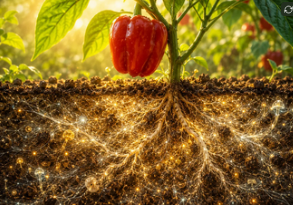
One ancient and extremely powerful bacterium — in our soil, our fermented foods, and our own gut — is dismantling glyphosate, protecting our cardiovascular system, modulating our immunity, and reminding us that “germs” have always been the medicine
There is a quiet, almost poetic symmetry in the way Nature responds to human folly.
We have saturated our soils with a synthetic molecule designed to dismantle the shikimate* pathway — the very pathway that bacteria in our guts depend on to make the amino acids that become our neurotransmitters, our connective tissue, our immune signals. We were told this molecule was safe for us because humans don’t possess the shikimate* pathway.
What we were not told, for decades, is that we are not only human. The 99% of our holobiont* selves that is microbial in origin does possess the shikimate pathway.
Glyphosat
*Shikimate (or shikimic acid) is a vital metabolic intermediate used by plants, fungi, bacteria, and algae to synthesize essential aromatic amino acids (phenylalanine, tyrosine, and tryptophan) and other secondary metabolites. Because humans and animals lack this pathway, it is a primary target for certain herbicides and antimicrobial drugs.e (poison), by mechanism, is an antibiotic against the very organisms that make us who we are.
*A holobiont is a single biological entity formed by a host (such as a plant, animal, or human) and its entire community of associated microorganisms, like bacteria, viruses, and fungi. Coined by biologist Lynn Margulis, the concept redefines an organism as a complex, interconnected ecological network.
And yet, hidden within the same biosphere we have so casually poisoned, there exists a single, humble bacterium that can take this molecule apart — bond by bond — while at the same time producing some of the most therapeutically powerful biomolecules known to medicine. It lives in the soil beneath our feet. It lives in the fermented foods of every traditional cuisine that survived industrialization. It lives in the rhizospheres of our food crops. And — as researchers have come to recognize only in the past two decades — it lives in our own gastrointestinal tracts, where it has been working as a quiet commensal partner for as long as our species has existed.
Its name is Bacillus subtilis.
This is the story of how one ancestral microbe braids together nearly every thread of the microbiome revolution: the extensibility of our biology through microbial partners, the continuity between soil and gut that makes us inseparable from the living Earth, the restorative intelligence of microbial life that can heal damage our own genome cannot even register, and the ancestral dietary inheritance through which our forebears continuously renewed this relationship long before any of us had the language to name it.
Before we go further into the science, a single image to anchor what we mean when we say “we.” Da Vinci’s Vitruvian Man — the Renaissance icon of human perfection as a self-contained, geometrically complete being — has been reimagined in contemporary microbiome science as the Holobiont: a body inseparable from the trillions of microbes, fungi, viruses, and food-derived signaling molecules with which it lives in constant biochemical conversation.
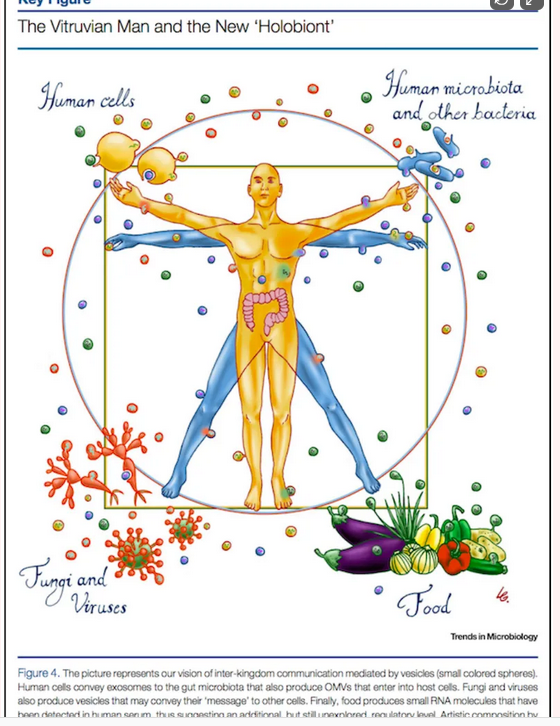
The small colored spheres are vesicles (exosomes, outer membrane vesicles, food-borne microRNAs) carrying inter-kingdom information across what we once thought were sealed biological boundaries. Originally published in Trends in Microbiology (artistic composition by Laura Galeazzo). I explored the deeper implications in Leonardo da Vinci and the New Biology. For the present article, it is enough to note: this is the body that Bacillus subtilis partners with — and the body glyphosate is unknowingly attacking.
The Damage Glyphosate Does to the Holobiont
To understand why the B. subtilis story matters, we must first sit with the scale of what glyphosate has done.
Glyphosate is the active ingredient in Roundup and is the most widely applied herbicide in agricultural history. It is sprayed onto Roundup-Ready GM crops, used as a pre-harvest desiccant on conventional wheat and oats, and applied to fields, lawns, parks, and roadsides on every inhabited continent. Its industrial defenders have repeated, for nearly half a century, that glyphosate is safe for mammals because mammals do not possess the shikimate pathway — the metabolic route through which plants, fungi, and bacteria synthesize the aromatic amino acids phenylalanine, tyrosine, and tryptophan.
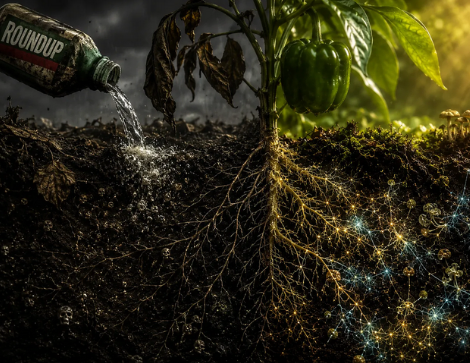
The argument is technically true and biologically dishonest. We do not possess the shikimate pathway. Our microbiome does. The bacteria of our gut — including the Lactobacillus and Bifidobacterium species that ferment our foods, modulate our immunity, produce our B-vitamins, and govern the gut-brain axis — depend on the shikimate pathway.¹ ² So do many fungi in our mycobiome. So do many soil organisms that build the living substrate beneath every meal we have ever eaten.
What the published research has now made unambiguously clear — across in vitro studies, animal models, and metabolomic analyses — is that glyphosate exposure selectively suppresses many of the beneficial members of the gut community while leaving certain pathogens relatively unscathed. Lactobacillus and Bifidobacterium have been shown to be more susceptible to glyphosate than Clostridium perfringens and certain Salmonella strains.³ The shikimate pathway has been documented as transcriptionally active across a meaningful fraction of human gut microbes,⁴ and metabolomic studies in rats have confirmed accumulation of shikimate-pathway intermediates — the biochemical fingerprint of glyphosate inhibition — inside living animals exposed to environmentally relevant doses.⁵ Samsel and Seneff first articulated the broader implications of this mechanism for chronic human disease in their 2013 Entropy review on glyphosate’s suppression of cytochrome P450 enzymes and microbial amino acid biosynthesis.¹
This is the meaning of glyphosate’s harm: it is not a “human toxin” in the narrow toxicological sense. It is a holobiont toxin. It targets the inner ecology that constitutes 99% of our genetic identity. Because the body it was poisoning was never recognized as a body by the regulatory science that approved it, the damage was allowed to accumulate, generation upon generation, until it now shows up in the epidemic curves of celiac disease, IBD, autism, depression, autoimmunity, and the metabolic disorders that increasingly define the modern human condition.
When we ask what glyphosate “does” to a person, the honest answer is: it does not act on the person at all. It acts on the microbial communities through which the person exists.
Bacillus subtilis: The Bacterium We Forgot We Knew
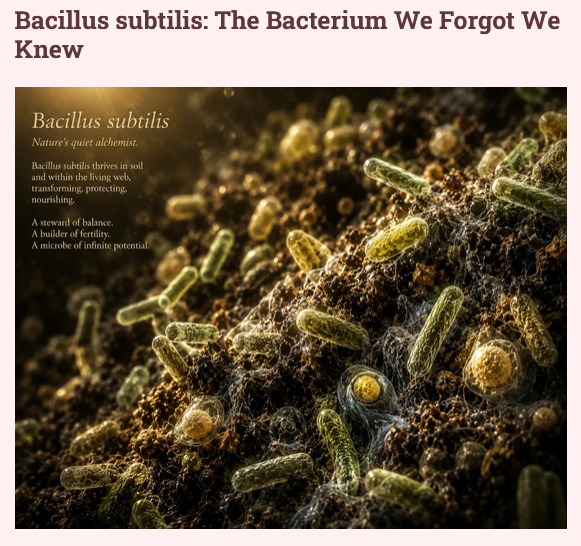
And yet, in the very soil that conventional agriculture has carpet-bombed, an older lineage of bacteria carries on its ancient work. Among them is Bacillus subtilis.
B. subtilis is one of the most studied organisms in all of biology. It is the textbook gram-positive bacterium, the model organism for sporulation, the workhorse of fermentation laboratories around the world. For most of the twentieth century, microbiologists classified it as a soil bacterium — a tidy designation that allowed us to think of it as separate from us, “out there” in the dirt. That classification has been quietly overturned.
In 2009, researchers at Royal Holloway University in London, working with strains isolated directly from ileum biopsies and fecal samples of healthy humans, demonstrated that B. subtilis had adapted to life inside the human gastrointestinal tract.⁶ The bacterium could sporulate anaerobically, secrete antimicrobials against pathogens, and form protective biofilms along the gut wall. Their conclusion was unambiguous: B. subtilis and other spore-formers should be considered “gut commensals rather than solely soil microorganisms.”⁶ Subsequent reviews have confirmed and extended this view, noting that B. subtilis spores survive cooking temperatures, the acidity of the stomach, and the bile of the small intestine — and that they germinate, grow, and contribute metabolically once they reach the gut.⁷
This is itself a small microbiome revolution. B. subtilis is not “out there” — it is, and has always been, part of us. Our ancestors, foraging unwashed roots and tubers, eating naturally fermented foods, drinking unfiltered spring water, breathing air thick with soil dust during planting and harvest, were continuously inoculated with this organism. It travelled with us, in us, alongside us, across continents and millennia. The boundary between the soil’s microbiome and ours, between the field and the gut, was never the hard line modern hygiene imagined it to be. It was, as the herbalist Paul Schulick named it, a life bridge — and B. subtilis is one of the species that walks it.
How Our Ancestors Met This Bacterium Every Day
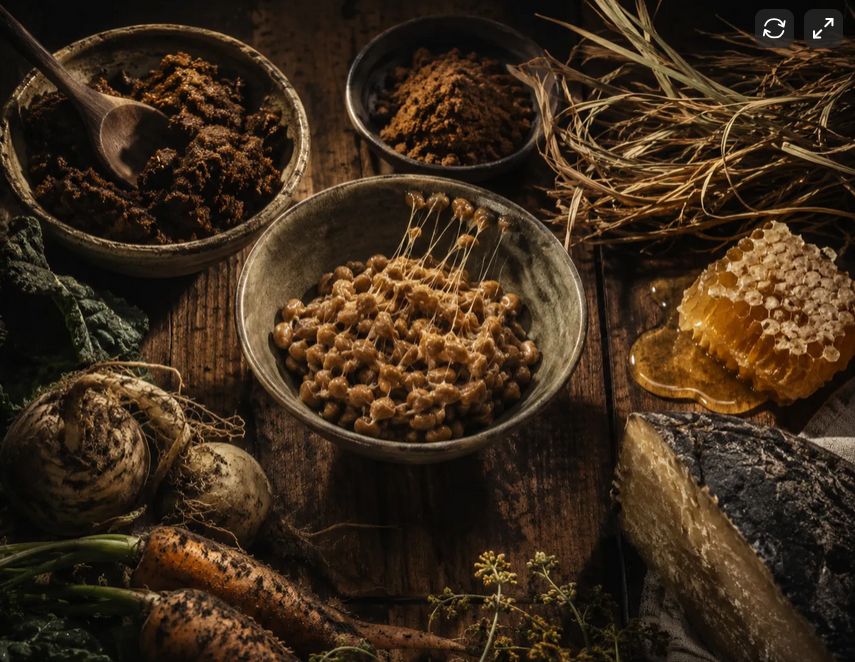
Long before “probiotic” became a marketing word, B. subtilis was already a daily dietary inheritance for human beings across the planet. It lived in the foods our ancestors knew were sacred — foods so often associated with longevity and vitality that traditional cultures built entire ritual practices around their preparation.
The most celebrated dietary source is natto, the traditional Japanese fermented soybean dish in which Bacillus subtilisvar. natto converts cooked soybeans into one of the most nutrient-dense, bioactive foods in the human dietary record.⁸ Eaten daily for centuries in regions of Japan associated with exceptional cardiovascular health and bone density,⁹ natto is a living culture — every spoonful contains billions of active B. subtilis organisms along with the cascade of bioactive molecules they produce.
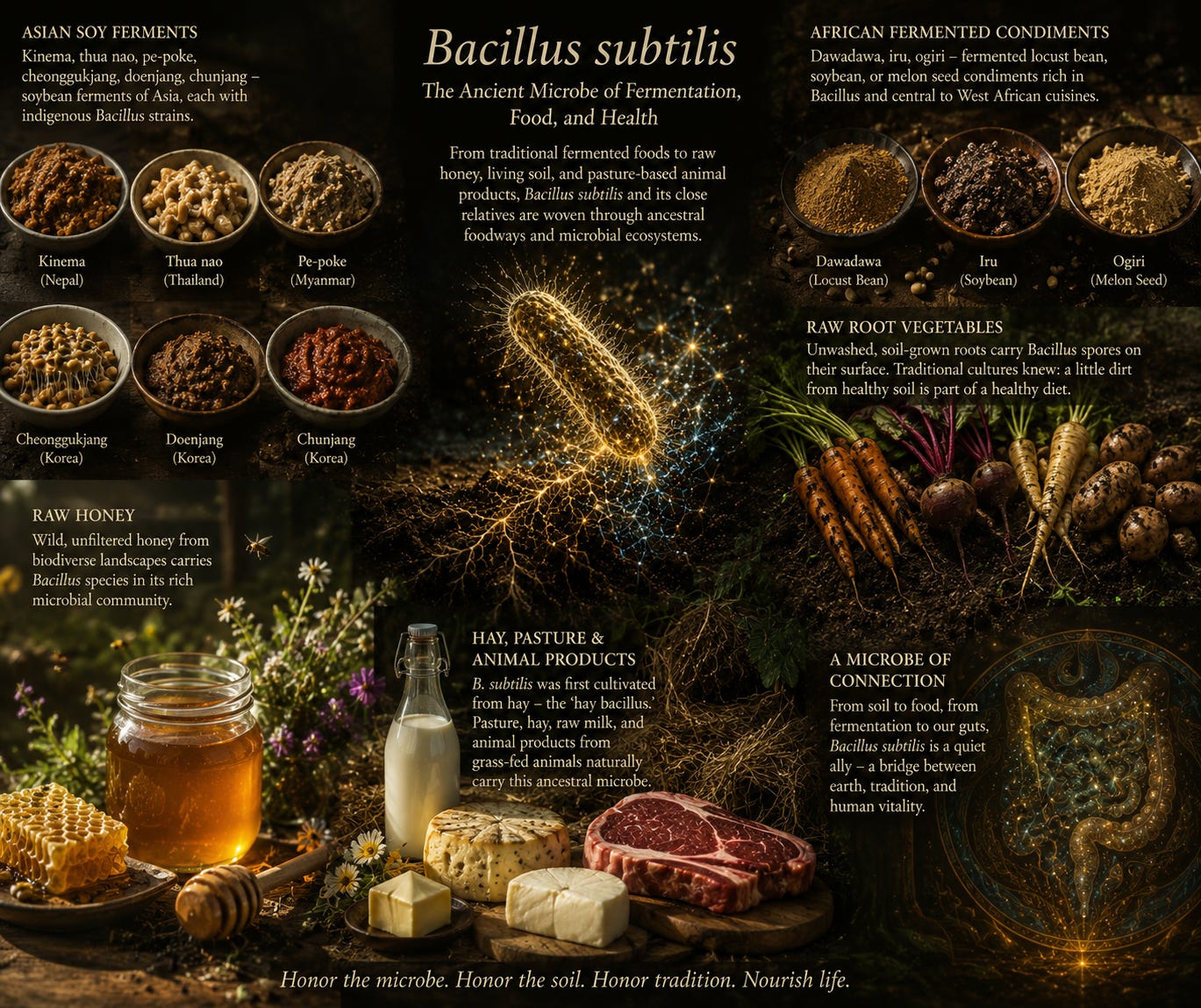
But natto is only the most famous example. B. subtilis and its close relatives are involved in fermentation of:
Kinema, thua nao, and pe-poke — the soybean ferments of Nepal, Thailand, and Myanmar, dietary parallels to natto with their own indigenous Bacillus strains

Dawadawa, iru, and ogiri — West African condiments fermented from locust bean, soybean, or melon seed, central to the cuisines of Nigeria, Ghana, Senegal, and surrounding regions

Cheonggukjang — the rapidly-fermented Korean soybean paste, traditionally aged on rice straw rich in wild Bacillus

Doenjang and chunjang — slower Korean fermented bean pastes carrying Bacillus alongside the more famous Aspergillus and Lactobacillus communities

Raw, unwashed root vegetables — carrots, beets, parsnips, and tubers pulled from healthy living soil carry B. subtilis spores on their surface, which is one reason traditional cuisines historically did not over-sterilize their produce, and why ‘eating dirt’ (albeit healthy sources in very small quantities) may be an essential part of health.

Wild and properly-tended honey — honey collected from hives surrounded by biodiverse pasture and forest harbors Bacillus species among its broader microbial signature [learn more about the microbial wonders of raw honey here]

Aged hay, grass-finished animal products, and raw milk from animals on pasture — B. subtilis was historically named hay bacillus because it was first cultivated from hay; pastured-animal foods naturally carry this organism
What this means, in plain biological terms, is that B. subtilis exposure was continuous for our ancestors. Not a once-a-week event. A daily, almost hourly inoculation through food, water, air, and soil contact. The modern lifestyle — sterile kitchens, washed produce, pasteurized everything, sealed packaged foods, dirt-free hands — has functionally eliminated this exposure for most people living in industrialized societies. We have, in effect, severed one of the oldest continuous microbial relationships in the human evolutionary record.
What This Bacterium Actually Does for Us
The reason B. subtilis mattered so deeply to our ancestors is not romantic. It is biochemical. This single organism is one of the most prolific producers of therapeutically active molecules in the entire microbial world. The peer-reviewed literature on its secondary metabolites now spans thousands of papers. A short list of what B. subtilis makes, while alive in our food or in our gut, includes:
Nattokinase. Produced during the fermentation of soy, nattokinase is a serine protease with potent fibrinolytic activity — it dissolves fibrin, the protein scaffold that holds blood clots together.¹⁰ It is one of the most extensively studied natural cardiovascular compounds in the literature, with documented effects on blood viscosity, atherosclerotic plaque, blood pressure, and circulatory function.¹⁰ ¹¹ Daily natto consumption has been associated, in Japanese population studies, with lower cardiovascular mortality and reduced stroke risk.⁹
Vitamin K2 as menaquinone-7 (MK-7). B. subtilis var. natto is, by a wide margin, the richest known biological source of MK-7 — the long-chain form of vitamin K2 with the longest half-life in human serum.⁸ ¹² MK-7 activates osteocalcin (which directs calcium into bone) and matrix Gla protein (which keeps calcium out of arterial walls). The clinical implications are significant: MK-7 supplementation has been associated with reduced arterial calcification, improved bone density in postmenopausal women, and lower cardiovascular mortality.¹² A 100-gram serving of natto contains roughly 1 milligram of MK-7, an amount essentially impossible to obtain from any other food.¹²
Surfactin. A cyclic lipopeptide and one of the most powerful biosurfactants known. Recent research has documented surfactin’s ability to enhance secretory IgA production, increase intestinal villus height, upregulate tight-junction proteins (claudin-1, occludin, ZO-1) that maintain gut barrier integrity, and reduce intestinal inflammation in models of induced colitis.¹³ Surfactin also has documented antiviral activity, including against enveloped viruses, and has been shown to inhibit the VEGF pathway involved in tumor angiogenesis — making it an emerging candidate in oncology research.¹⁴
Subtilisin and related proteases. Powerful protein-digesting enzymes that contribute to the breakdown of dietary proteins (including the difficult-to-digest gluten proteins of wheat) and to the catabolism of damaged proteins in tissues. B. subtilis proteases are part of the reason traditional fermented soy foods are more digestible than unfermented soy.
Bacteriocins and antimicrobial peptides. A broad arsenal of compounds — subtilin, mycosubtilin, fengycin, iturin, plipastatin — with documented activity against pathogenic bacteria (including methicillin-resistant Staphylococcus aureus), pathogenic fungi (including Candida albicans), and certain viruses.¹⁴ These compounds are part of how B. subtilis in our gut helps maintain the microbial balance that resists opportunistic infections.
Folate, riboflavin, biotin, and other B-vitamins. Like many beneficial gut commensals, B. subtilis contributes directly to the synthesis of essential cofactors our own cells cannot produce.⁷
Immune-modulating spore-coat proteins. Even before germination, B. subtilis spores interact with gut-associated lymphoid tissue (GALT), training the immune system, biasing it toward tolerance rather than reactivity, and contributing to the gut-immune axis that determines so much of our overall health.⁷
This is the supra-human principle in plain biochemistry. We could not, with our human genome alone, make these molecules. We borrow them — daily, ancestrally, through diet and exposure — from a microbial partner whose chemical capabilities vastly exceed our own.
The Clinical Picture: What Happens When We Restore the Relationship
