Welcome, Guest
Login/Register
There is just so much information like this available now – it’s hard to imagine that people are still victim to this form of ‘treatment’
How Statins Damage and Weaken the Heart
What the Biomedical Literature Reveals About Cardiac Dysfunction and Cholesterol-Lowering Drugs
Sayer Ji
Jan 12
https://sayerji.substack.com/p/the-cholesterol-con-how-statins-became

Sayer Ji – Health, Truth, and Freedom sayerji@substack.com

Statins are marketed as heart-protective drugs, yet their primary biological effects may weaken the heart itself.
For more than three decades, statins have been widely prescribed under the assumption that lowering cholesterol—specifically low-density lipoprotein (LDL)—translates into cardiovascular protection. Over time, this assumption has calcified into medical dogma, reinforced by clinical guidelines, pharmaceutical marketing, and statistical framings that favor surrogate markers over biological reality. Yet a growing body of biomedical evidence points to a far more uncomfortable conclusion.
This pattern of well-intended but scientifically oversold interventions is not unique to statins. It also appears in other areas of cardiovascular care, including common supplements—such as calcium—where presumed benefits have masked unanticipated harms, a topic I explore in depth elsewhere.
According to research indexed in PubMed and the National Library of Medicine, statin drugs are now associated with more than 350 documented adverse health effects, impacting nearly every major physiological system. These findings are not anecdotal or fringe. They are cumulative, reproducible, and increasingly difficult to reconcile with the claim that statins are biologically benign—let alone intrinsically cardioprotective.
The deeper issue is not merely the number of adverse effects, but their nature.
A drug that damages muscle tissue, impairs mitochondrial energy production, disrupts metabolic signaling, and injures peripheral nerves cannot logically be assumed to protect the most energy-demanding, nerve-dense muscle in the human body: the heart.
For more than a decade, beginning in 2012, I have been issuing public alerts about these overlooked risks. Through GreenMedInfo, I began systematically documenting and indexing the peer-reviewed literature linking statins to muscle injury, mitochondrial dysfunction, metabolic disruption, neurological harm, and paradoxical cardiovascular impairment. Today, thousands of published studies substantiate these concerns, forming an evidentiary record that remains largely absent from mainstream patient risk–benefit discussions despite its clear clinical relevance.
Cholesterol’s vilification rests on a fundamental misinterpretation of biology. Cholesterol is not a metabolic toxin; it is a structural, functional, and protective molecule, essential for:
Cell membrane integrity / Hormone and vitamin D synthesis / Immune defense and pathogen neutralization / Myelin formation and nerve conduction Tissue repair at sites of injury
As one of my colleagues once wrote, Cholesterol: It’s All Good.
https://greenmedinfo.com/blog/cholesterol-its-all-good
Share
Low-density lipoprotein (LDL) cholesterol is frequently detected within atherosclerotic plaque, but its presence alone does not establish causation. Crucially, the cholesterol found in plaque is predominantly oxidized LDL (ox-LDL)—a form that is biologically and chemically distinct from native, healthy cholesterol. Ox-LDL increases in the body in parallel with oxidative stress and toxic burden, both of which are modifiable risk factors largely influenced by diet, metabolic health, environmental exposures, physical activity, and stress regulation. Garlic, for example, is one of a wide range of natural substances capable of mitigating LDL oxidation. There are 100 more you can explore here.
https://greenmedinfo.com/disease/cholesterol-oxidation

A substantial body of research demonstrates that endothelial injury precedes plaque formation, with damage driven by inflammation, oxidative stress, glycation, infection, and exposure to environmental toxins. Cholesterol accumulation appears downstream of these processes, not as their primary cause. Once again, addressing the root causes: endothelial dysfunction, or vitamin C deficiency, is the whole point. You can view my previous deep dive into the relationship between the heart disease epidemic and scurvy below:
What Really Causes Heart Disease — And Why Pennies’ Worth of Missing Nutrients May Prevent (and Reverse) It
Sayer Ji
·
November 17, 2025
What Really Causes Heart Disease — And Why Pennies’ Worth of Missing Nutrients May Prevent (and Reverse) It
View and share the X thread dedicated to this article: https://x.com/sayerjigmi/status/1990406846864109770?s=20
Blaming cholesterol for heart disease is akin to blaming firefighters for a fire simply because they arrive at the scene. Meaningful prevention and cure require examining the conditions that give rise to pathology in the first place and removing them—while recognizing the adaptive, self-protective, and regenerative responses operating beneath the surface of symptoms.
The Scope of Statin Harm: A Pattern, Not a Coincidence
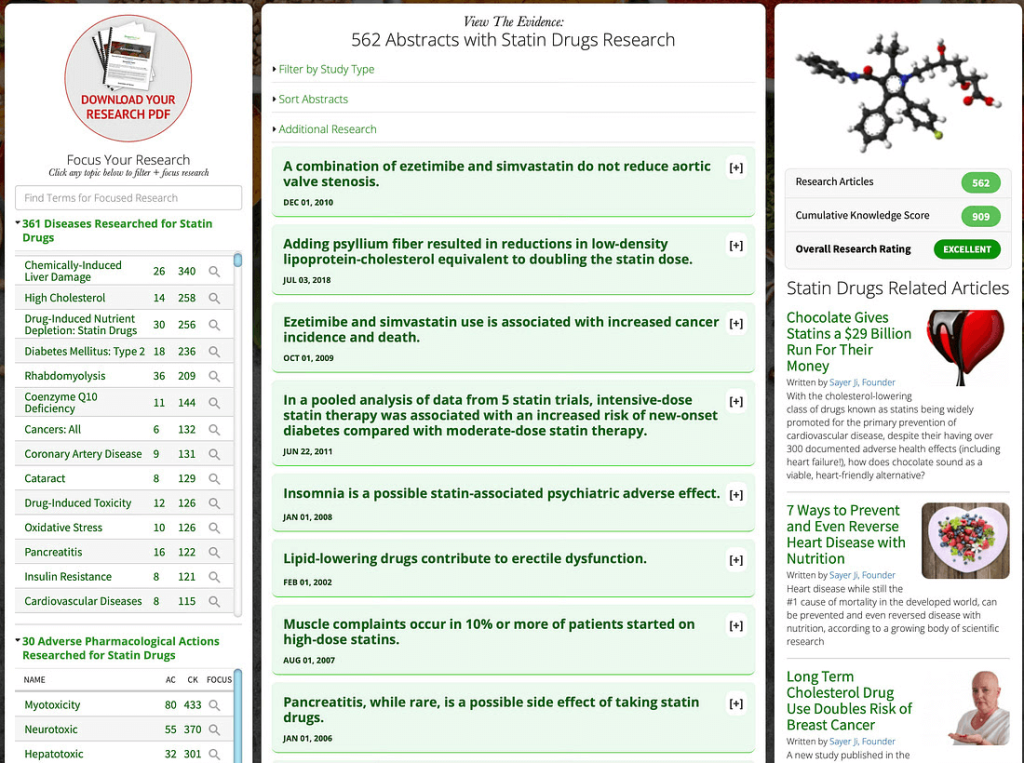
The GreenMedInfo statin database documents 350+ adverse health effects across more than 30 biological pathways.
These effects are not random. They cluster around a few central mechanisms, forming a coherent pattern of systemic injury.
The most heavily documented categories include:
Muscle damage (myotoxicity) – over 80 studies / Nerve damage (neurotoxicity) – over 50 studies / Liver injury (hepatotoxicity) / Endocrine and metabolic disruption / Mitochondrial dysfunction and energy depletion / Cognitive and psychiatric effects / Cardiovascular damage, including heart failure and arrhythmias
This is not what a “targeted” therapy looks like. To the contrary, statin drugs appear to do one thing universally: harm the body, with the minor ‘side benefit’ in a certain subpopulation of users (e.g. anti-inflammatory properties), and even that is a stretch. To really did deep into this topic, read my article Cracking the Cholesterol Myth: How Statins Harm The Body and Mind
Statins as Muscle-Damaging Agents — Including the Heart
Statins are among the most well-documented myotoxic (muscle-damaging) drugs in modern medicine. Muscle injury may present as pain or weakness, but research shows that structural muscle damage often occurs silently, without abnormal blood markers.
This is particularly relevant to the heart.
The heart is a continuously active muscle with extraordinary mitochondrial demands. When energy production is impaired and muscle fibers are damaged, function declines—not immediately, but progressively.
Human studies have now demonstrated that statins can:
Weaken cardiac muscle / Impair diastolic function / Increase risk of heart failure / See GreenMedInfo page on cardiomyopathy research
These outcomes are not paradoxical. They are biologically predictable.
Neurotoxicity: Undermining the Nervous System That Controls the Heart
Statins are also neurotoxic. Published studies associate their use with peripheral neuropathy, memory loss, cognitive impairment, depression, and mood disturbances.
This matters because:
Roughly 25% of the body’s cholesterol resides in the brain
Cholesterol is essential for myelin, synapse formation, and neuronal signaling
The heart is one of the most highly innervated organs in the body
The autonomic nervous system governs heart rate, rhythm, and responsiveness. A drug that compromises nerve integrity cannot plausibly preserve cardiac coherence.
As neurologist David Perlmutter, MD, has observed:
“Cholesterol is not the enemy of the brain; it is one of its most critical building blocks.”
Finally, for those looking for a more in depth analysis of the cholesterol myth and the toxicity of statins, you can read my previous report on the topic below.

