
Welcome, Guest
Login/Register
| Sayer Ji – Truth, Sovereignty, Wellness |
The CLOVE that cured every wart:
What a forgotten study tells us about the intelligence of plants
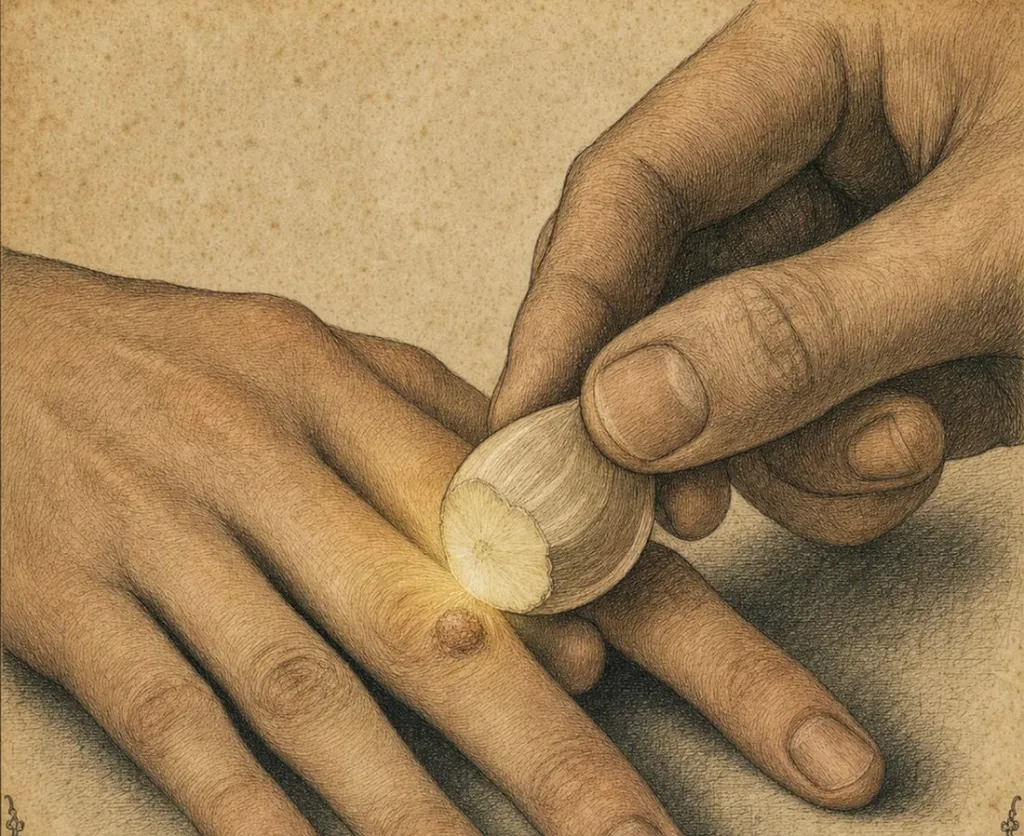
How a common kitchen bulb outperformed the entire dermatology clinic — and why that should not surprise us
“Let food be thy medicine and medicine be thy food.”
— attributed to Hippocrates, who prescribed garlic for infections, wounds, and tumors twenty-four centuries ago.
There is a particular kind of result that the modern medical literature produces every so often and then quietly buries. Not an incremental improvement. Not a “statistically significant trend.” A clean, total, almost embarrassing result — the kind that, if a pharmaceutical company owned it, would be on every billboard in the country.
This is one of those I recently featured in a set of over 250 natural substances researched to have therapeutic potential and safety superior to pharmaceuticals, albeit in mostly preclinical research.
In 2005, four researchers at Shiraz University of Medical Sciences published a small clinical study in the International Journal of Dermatology with a title so plain it almost dares you to overlook it: “Healing effect of garlic extract on warts and corns.” What they reported was this: a fat-soluble extract of ordinary garlic, applied twice a day, produced complete recovery in 100% of patients with warts within one to two weeks — and no recurrence over the three-to-four-month follow-up.
One hundred percent. From a bulb you can buy for pocket change at any market on earth.
I want to sit with this result, because it is not really a story about warts. It is a story about what we have been taught to believe medicine is, and where healing actually comes from.
I. What the Study Actually Found
Let me give you the numbers plainly, because they deserve it.
The trial enrolled 42 patients: twenty-eight with anywhere from 2 to 96 warts, nine with corns, and a control group. The researchers prepared garlic two ways — a water-based (aqueous) extract and a fat-based (lipid) extract — and this distinction turned out to matter enormously (Dehghani et al., Int J Dermatol, 2005).
The water extract worked, but slowly: small warts disappeared, larger ones partially improved, and full benefit took more than two months.
The fat-soluble extract was a different order of thing entirely. In the twenty-three patients treated with it, every single case of warts cleared completely in one to two weeks.
Seven of nine corn patients fully recovered; the other two came close. The treatment for corns took ten to twenty days.
The control group — treated only with the solvent, no garlic — showed no improvement at all.
And then the detail that should stop you: in patients with numerous warts, the researchers treated only one or two of them — and the untreated warts in the same area disappeared too (Townsend Letter analysis). The body, given the right signal in one place, generalized the healing.
This is not the behavior of a chemical burning off tissue. This is the behavior of an immune system being informed.
II. Why Fat-Soluble Mattered — and What It Tells Us
The single most instructive finding in this study is the one most likely to be skimmed past: the fat-soluble extract vastly outperformed the water-soluble one.
This is not an accident, and it is not trivial. It is a clue about how plant medicine actually works.
Garlic’s prized compounds — allicin and the cascade of organosulfur molecules it gives rise to — are lipophilic. They move through membranes, which are themselves made of fat.
The fat-soluble preparation could enter the tissue, reach the virally infected cells, and act. The water extract sat largely on the surface.
The lesson here is one I have returned to again and again: the form of a natural medicine is not incidental to its power — it is the power. Strip a plant down, isolate the “active ingredient,” deliver it in the wrong vehicle, and you can render a 100%-effective remedy nearly inert. Honor the plant’s own chemistry, and it does what it has done for millennia. The reductionist habit of asking only “what is the single molecule?” misses that the matrix, the delivery, the whole is where the intelligence lives.
III. Four Mechanisms, One Garden
What makes this result so much more than a folk curiosity is that the researchers could name why it worked — and the mechanisms read like a summary of everything garlic has been documented to do across the scientific literature.
It is antiviral. Warts are linked to human papillomavirus. Garlic’s antiviral activity is among the best-established in all of botanical medicine — it directly interferes with viral replication (Dehghani et al., 2005).
It is antiproliferative. A wart is, in effect, a benign virally-driven growth. Garlic has been studied for activity against a wide range of abnormal and cancerous cell lines — the same property, turned toward a humbler target (Garlic in dermatology, Dermatology Reports, 2011).
It is immunomodulatory. The authors suspected that garlic’s deepest action was not to attack the wart directly but to wake the immune system — which is exactly what would explain untreated warts vanishing alongside treated ones.
It is fibrinolytic. For the corns, garlic dissolved the fibrin tissue holding the lesion in place, so the corn simply separated from the healthy tissue beneath.
No scalpel. No cautery. The plant unbound what should never have been bound.
Antiviral. Antiproliferative. Immune-awakening. Tissue-dissolving. We did not engineer these four activities into garlic. They are simply what it is — a single organism that happens to carry, in its quiet chemistry, a coordinated pharmacy.
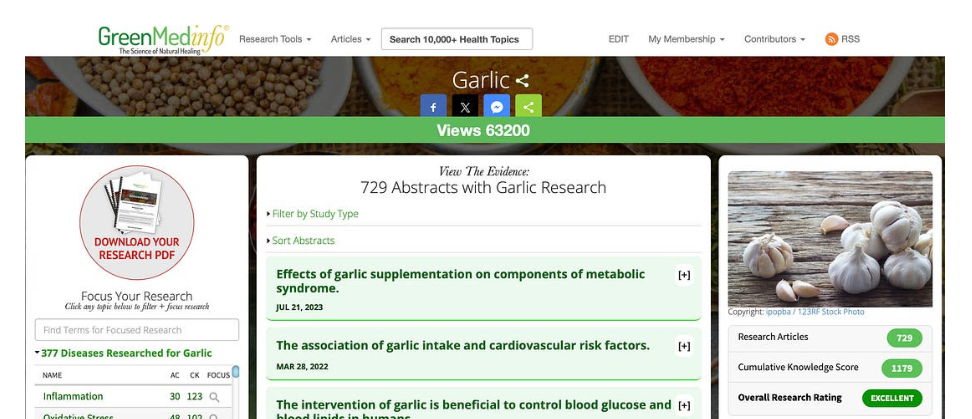
And this is only the tip of a massive iceberg of potential therapeutic benefits. Consult the GreenMedInfo.com database Garlic to explore the astounding amount of research on this food and herb studied for over 370 conditions, known to modulate over 138 known pharmacological actions.
IV. The Comparison the Study Quietly Makes
The researchers did something braver than report their results. They placed them next to the standard of care.
Here is what a wart patient is typically offered in the clinic, in their own words:
electrocautery (burning the lesion off), cryotherapy (freezing it off with liquid nitrogen), or keratolytics (acids that eat the tissue away).
Their assessment of these methods is devastating in its restraint: “These approaches are not fully successful, and in some cases warts reappear.”
For corns, the conventional answer is surgery — which they note “can be painful and costly” (Dehghani et al., 2005).
So set the two side by side.
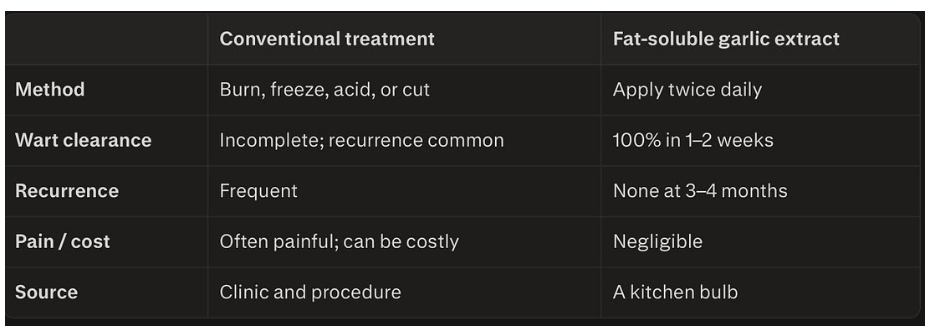
One column is built on force — we will destroy the lesion. The other is built on intelligence — we will resolve the conditions that produced it.
One leaves the underlying viral terrain untouched, which is why the warts so often return.
The other appears to enlist the body’s own defenses, which is why, in this study, they did not.
This is the difference between a paradigm of war and a paradigm of cooperation. It is the same fault line that runs through nearly every question in medicine today.
V. The Real Lesson: An Intelligence We Did Not Author
I do not want you to walk away from this thinking the point is “rub garlic on your warts.” (Though if you do, please note the real caution: the lipid extract is potent enough to blister healthy skin, which is exactly why the original researchers protected the surrounding tissue with zinc oxide. Power is not the same as harmlessness.)
The point is larger.
We live inside a story that says healing is something we invent — synthesized in a lab, owned by a patent, dispensed through a clinic, and fundamentally separate from the living world. This study, and ten thousand like it, tells a different story. It says that a plant pulled from the dirt, with no human improvement whatsoever, can carry within its ordinary cells a remedy more complete than what the entire apparatus of modern dermatology offers for the same complaint.
That should reorganize how you see the garden.
The clove of garlic did not “become” a medicine when a journal validated it in 2005. It was already a medicine when Hippocrates prescribed it, when Egyptian laborers ate it to ward off illness, when Russian field doctors called it penicillin in the wars. The study did not create the healing. It only, briefly, noticed it — before the literature moved on and the result was left to gather dust.
Nature is not a crude first draft that pharmacology later perfects. It is the original text. We are, at best, still learning to read it.
The most radical thing you can do, in a culture that has forgotten this, is to take it seriously: to treat the plant world not as a primitive pharmacy awaiting our refinement, but as a living intelligence that was solving the problems of life long before we arrived — and is offering its answers still, in the most ordinary places. On the windowsill. In the soup. In a single, unremarkable, hundred-percent-effective clove.
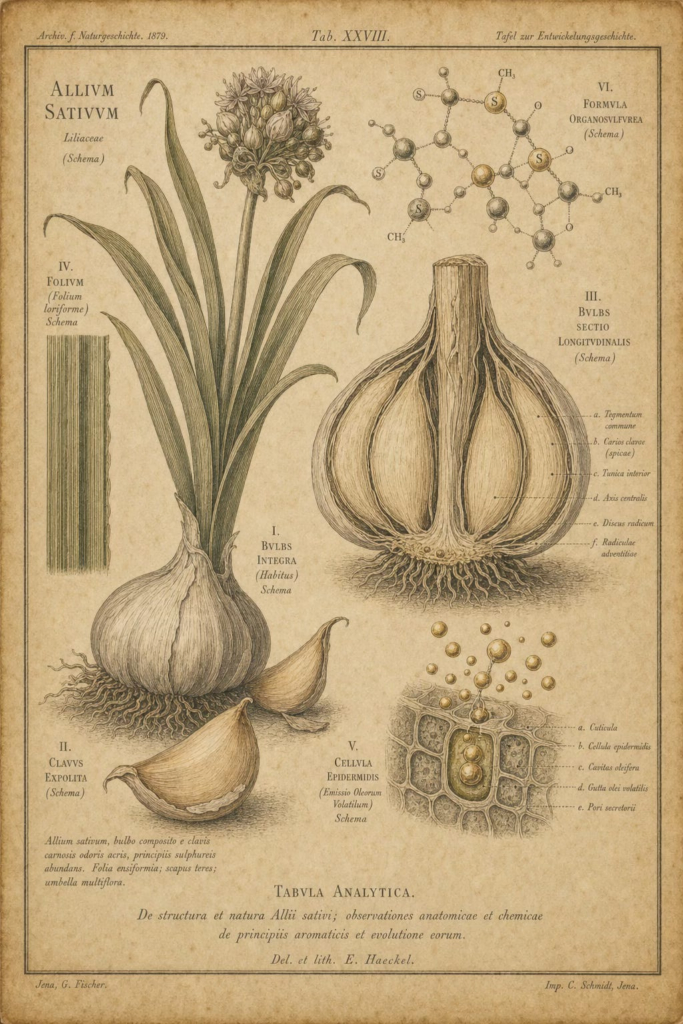
The anatomy of a remedy. Allium sativum dissected in the manner of a 19th-century botanical plate — the bulb, the clove, and the lipophilic sulfur compounds (allicin and its kin) that carry garlic’s fourfold action: antiviral, antiproliferative, immunomodulatory, fibrinolytic.
This essay is a meditation on what the science reveals, not medical advice. Topical garlic extracts are genuinely potent and can cause chemical burns, blistering, and hyperpigmentation on healthy skin — the original researchers used zinc oxide to shield the surrounding tissue for exactly this reason. Persistent or spreading warts, and anything you are unsure about, deserve a knowledgeable practitioner. Honor the plant’s power by respecting it.
If this resonated, it lives alongside my ongoing work on the hidden intelligence of the natural world — the new biology of plants, the body’s porousness, and the case that healing is something we participate in rather than manufacture. Both my book REGENERATE and my masterclass REGENERATE YOURSELF support a deep exploration into ways to empower yourself with the tools and knowledge needed to live the best version of yourself.

