
Welcome, Guest
Login/Register

A double-blind clinical trial found that an ancient honey-coffee remedy virtually eliminated cough symptoms — outperforming a steroid drug by a factor of 14.
So why isn’t your doctor prescribing it?
Every year, billions of dollars are poured into the pharmaceutical management of chronic and persistent cough — one of the most common reasons people visit a doctor worldwide.
For post-infectious persistent cough (PPC), the kind that lingers for weeks or months after a cold or respiratory infection, the standard arsenal includes steroids, narcotics, antihistamines, and centrally acting antitussives like codeine and dextromethorphan.
NB !!
These are serious drugs with serious consequences
But what if the most effective treatment isn’t a pharmaceutical at all?
What if it’s a combination so ancient, so accessible, and so inexpensive that it can be prepared in any kitchen on earth?
A landmark double-blind, randomized clinical trial published in the Primary Care Respiratory Journal found exactly that: a simple paste of honey and coffee was not just as good as the steroid prednisolone for persistent cough — it was dramatically, overwhelmingly superior.
The Study That Should Have Changed Everything

Researchers at Baqiyatallah University Hospital in Tehran conducted a rigorous three-year study (2008–2011) enrolling 97 adults with post-infectious cough persisting for more than three weeks. Participants were randomized in double-blinded fashion into three groups, each receiving a jam-like paste dissolved in warm water, taken every eight hours for one week:
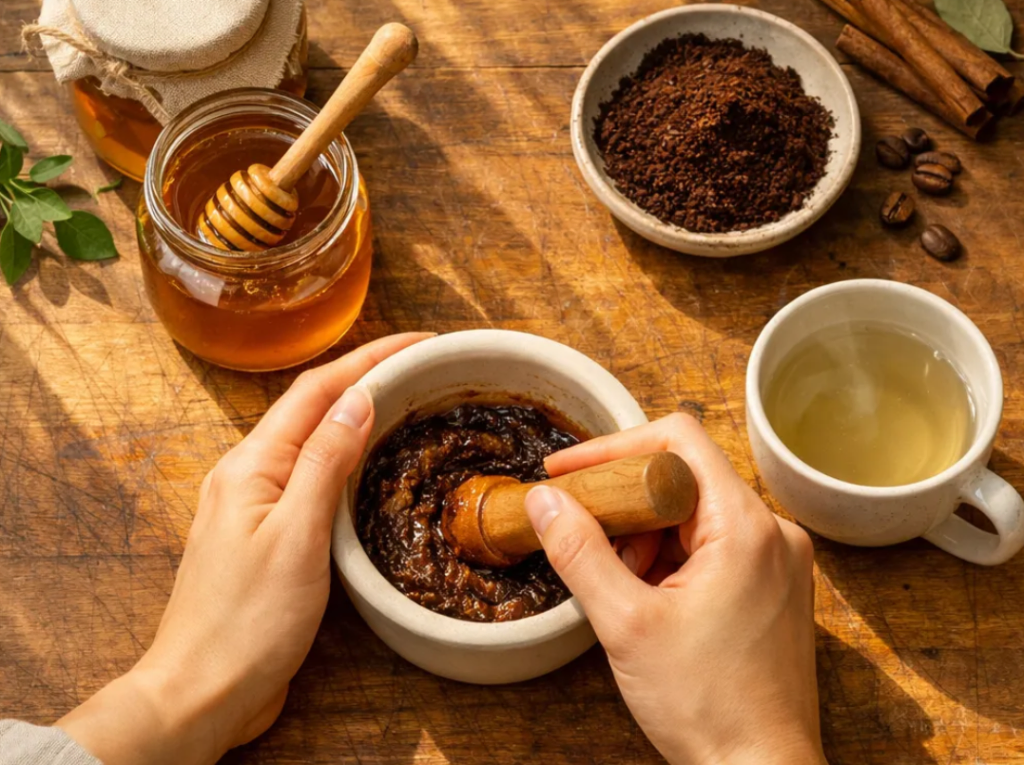
Group 1 (Honey + Coffee): 20.8 grams of honey combined with 2.9 grams of instant coffee
Group 2 (Steroid): 13.3 mg of prednisolone
Group 3 (Control): 25 mg of guaifenesin
The results were not merely statistically significant. They were stunning.
The honey-coffee group saw cough scores plummet from 2.9 to 0.2 — a near-total elimination of symptoms (p<0.001). The prednisolone group improved only modestly, from 3.0 to 2.4 (p<0.05). The control group showed no meaningful change at all, moving from 2.8 to 2.7.
Let those numbers sink in. The honey-coffee combination achieved a 93% reduction in cough severity. The steroid achieved a 20% reduction. The natural remedy didn’t just edge out the pharmaceutical — it outperformed it by a factor of approximately fourteen.
The study authors concluded: “Honey plus coffee was found to be the most effective treatment modality for PPC.”
This Is Honey as Medicine — Not a Sweetened Latte
Before the wellness-industrial complex reduces this finding to another “add honey to your morning coffee” trend piece, we need to be precise about what this study actually demonstrated. The therapeutic agent in this formula is honey — functioning as the medicinal base. Coffee serves as a synergist, amplifying honey’s effects through caffeine’s bronchodilatory and anti-inflammatory properties.
This distinction is not academic. It is the difference between medicine and marketing.
Be sure to use 100% natural honey
The researchers explicitly chose honey as the vehicle and foundation of this remedy, preparing it as a jam-like paste — a concentrated therapeutic dose of approximately 21 grams of honey per serving, taken three times daily. This is not a teaspoon swirled into a mug. This is an intentional, dosed medicinal preparation that mirrors how honey has been employed as a primary therapeutic agent across thousands of years of traditional medical practice.
The study’s authors warned directly against substituting honey with sugar or artificial sweeteners, noting that the remedy’s efficacy depends on the unique pharmacological properties of honey itself. And a 2023 comprehensive review of 48 clinical trials confirmed why: honey delivers a constellation of bioactive compounds — flavonoids, polyphenols, phenolic acids, enzymes, minerals, and vitamins — that work synergistically across multiple physiological pathways simultaneously.
Prednisone’s “Side Effects” vs. Honey’s “Side Benefits”
Here is where the story becomes not just medically interesting, but morally urgent.
When a doctor prescribes prednisolone or prednisone for a persistent cough, the patient is rarely told the full cost of that prescription. Corticosteroids, even in short courses, carry a documented burden of adverse effects that reads like a catalog of iatrogenic disease:
Immune suppression — the very system your body needs to clear the underlying infection is actively dismantled. Corticosteroids suppress T-cell function, reduce antibody production, and impair the innate immune response, leaving patients vulnerable to secondary infections.
Bone density loss — glucocorticoids are the most common cause of secondary osteoporosis, disrupting calcium absorption and accelerating bone resorption even in short-term use.
Blood sugar dysregulation — steroid-induced hyperglycemia occurs in up to 50% of hospitalized patients receiving glucocorticoids, and even outpatient courses can destabilize glucose metabolism.
Adrenal suppression — the hypothalamic-pituitary-adrenal axis can be disrupted, leaving the body unable to mount its own cortisol response to stress even after the drug is discontinued.
Mood and cognitive disturbances — insomnia, anxiety, agitation, psychosis, and depression are well-documented psychiatric effects of corticosteroids.
Gastrointestinal damage — increased risk of gastric ulceration and GI bleeding, particularly when combined with NSAIDs.
Weight gain, fluid retention, and metabolic disruption — the familiar “moon face” of steroid use is just the visible marker of deep metabolic derangement.
Ask your doctor if these side effects of harmaceuticals are right for you! (note added)
………………………………………………………………………………………………………………………………………………………………………………
The Good Side:
Now consider what happens when a patient takes the honey-coffee remedy instead. Instead of a cascade of adverse effects, the published literature documents what can only be described as a cascade of side benefits.
The GreenMedInfo database on honey (greenmedinfo.com/substance/honey) catalogs over 300+ research abstracts documenting honey’s therapeutic properties across 200+ different health topics. Among the documented benefits:
Immune enhancement — rather than suppressing immunity, honey strengthens it. Research shows honey contains oligosaccharides that function as prebiotics, enhancing phagocytosis by neutrophils, increasing lymphocyte counts, and boosting haematopoiesis. Where prednisone strips the body’s defenses, honey fortifies them.
Anti-inflammatory action — honey achieves inflammation modulation through phenolic compounds and flavonoids without the metabolic devastation of synthetic corticosteroids. It addresses inflammation at its source while supporting tissue repair.
Antimicrobial activity — honey provides broad-spectrum antimicrobial effects, including documented activity against antibiotic-resistant pathogens like MRSA. For a post-infectious cough, this means the remedy is simultaneously addressing residual microbial activity while soothing symptoms.
Wound healing and tissue repair — the respiratory mucosa damaged by infection benefits from honey’s well-documented capacity to promote epithelial regeneration. Clinical trials confirm honey’s superiority for wound healing, mucositis from chemo-radiotherapy, and tissue recovery.
Cardiovascular protection — a comprehensive review of clinical trials found more beneficial effects on cardiovascular and metabolic risk factors from honey than negative effects, including improvements in lipid profiles and blood pressure markers.
Metabolic support — far from destabilizing blood sugar like prednisone, honey has demonstrated improved glucose tolerance in both healthy and diabetic subjects, particularly when replacing other sweeteners.
Gastrointestinal healing — where prednisone damages the gastric lining, honey protects it. Documented benefits include inhibition of Helicobacter pylori, the bacterium responsible for gastritis and peptic ulcers, along with therapeutic effects on diarrhea and gastroenteritis.
Demulcent respiratory coating — honey provides direct physical soothing of irritated respiratory passages, coating inflamed tissue with a protective layer that reduces the cough reflex at its mechanical source. The World Health Organization acknowledges honey as a demulcent for cough and upper respiratory tract symptoms.
Antioxidant protection — honey’s rich content of phenolic compounds, particularly in darker varieties, provides systemic antioxidant support that protects against oxidative stress — a key driver of persistent inflammatory cough.
In other words: where prednisone trades one problem for many, honey addresses one problem while improving many others. The concept isn’t “side effects” — it’s side benefits.
The coffee in this formula is not incidental, but understanding its role correctly matters. Coffee contributes to the remedy’s extraordinary efficacy through several mechanisms.
Caffeine is a well-established bronchodilator, relaxing airway smooth muscle and improving airflow — a direct benefit for persistent cough. It is also a known anti-inflammatory agent that modulates adenosine receptors involved in the cough reflex. Research documented on GreenMedInfo identifies over 100 health applications for coffee and 33 distinct pharmacological actions.
Coffee’s antimicrobial power extends even further. A study published in the Annals of Family Medicine found that regular coffee consumption slashed nasal MRSA colonization risk by approximately 50% — a finding with profound implications given that MRSA kills an estimated 6,500 Americans annually. In a honey-coffee preparation, you have two ingredients independently documented to combat antibiotic-resistant pathogens — working together in a single dose.
But there is a deeper layer. Coffee contains cafestrol, an opiate-receptor-active compound present in both caffeinated and decaffeinated preparations, which may modulate cough signaling through mechanisms similar to (but far safer than) the narcotic antitussives prescribed for persistent cough. It also contains trigonelline, a compound associated with dopamine release and neurite outgrowth — effects that may explain coffee’s long history as a mood-elevating medicinal, known to the Sufi mystics who first cultivated it as qahhwat al-bun, “wine of the bean.”
In Chinese medical tradition, coffee is understood to stimulate Qi, invigorate circulation, and act as a “bitter” that supports digestion and metabolism — properties that complement honey’s nourishing, building, and restorative qualities.
The honey-coffee combination, then, is not a random pairing. It is an intelligently synergistic formula: honey as the foundational medicine providing demulcent coating, immune support, anti-inflammatory action, antimicrobial activity, and tissue repair — coffee as the activating synergist providing bronchodilation, anti-tussive signaling modulation, and enhanced bioavailability.
There is an important caveat to coffee’s therapeutic profile that deserves honest acknowledgment. Coffee contains cafestol, a diterpene with documented opioid-receptor binding activity — present in both caffeinated and decaffeinated forms. This is not merely caffeine dependence. Coffee simultaneously activates opioid and dopamine pathways, creating a multi-layered neurochemical attachment that helps explain why habitual use can become compulsive.

This is precisely why the honey-coffee cough remedy should be understood as a medicinal preparation — taken at a specific dose, for a defined period, to address a specific condition — not as a license for daily recreational consumption. The same compound (cafestol) that may contribute to the remedy’s anti-tussive effect through opioid-receptor modulation is also the compound that makes coffee habit-forming. Respect it as you would any pharmacologically active substance. Use it with intention.
Source:
https://sayerji.substack.com/p/a-spoonful-of-honey-and-coffee-did
